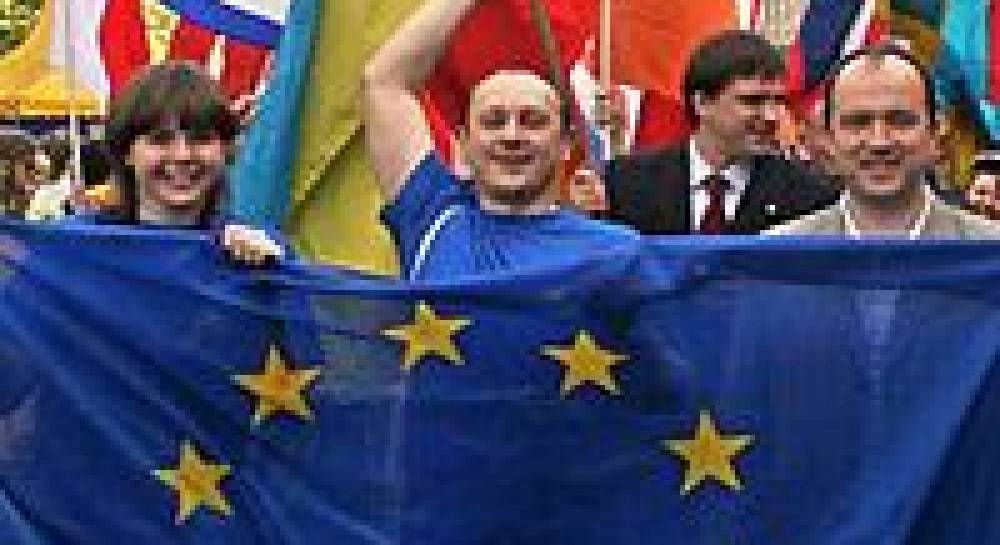
The dangers to the EU of condemning Ukraine and Belarus to political limbo
The dangers to the EU of condemning Ukraine and Belarus to political limbo
12:37, 05.05.2008
6 min.
When it comes to a new enlargement round in eastern Europe, the EU can`t go forward and can`t go back. Krzysztof Bobinski looks at the unpalatable choices that now confront Brussels...
One of the merits of the Berlin Wall was that it marked a finite border for the European project. It meant that few bothered to ask where does Europe end? The answer was obvious. But with its unlamented fall almost 20 years ago, that question of where Europe`s borders might end up has become a staple of the European debate.
The collapse of the Wall in 1989 saw European Commission officials dusting off their atlases to search for places about which they knew little and cared less. Leon Brittan, then a commissioner and supporter of enlargement, recalls that some officials and countries even hoped that the pre-1989 line could be held. They felt that enlargement even to the Scandinavian and Alpine countries was going too far. It was only in 1993 that the Council officially recognised that membership for all the former Soviet bloc countries could be a long-term goal. "There were many sceptics in the College of Commissioners with whom I often locked horns," he has since written. And it took a further four years for the new round of membership talks to get started.
Now, with the accession of the 10 former command economies, the sceptics are much fewer. But the pressure to enlarge once more to the east is still there. Now that they`ve been dusted off, those atlases are kept close to hand in EU offices. And in contrast to the 1990s, the debate on Europe`s frontiers is not confined to officials or think-tankers. In mid-2005 the voters came on the scene when in France and the Netherlands they rejected the constitutional treaty. Both decisions were partly motivated by a fear that enlargement was going too fast and too far. "We don`t want the Romanians deciding on how we should order our lives" a Dutch professor recently complained. Evidently a pause was needed.
Видео дня
Many of the former Soviet Republics, with aspirations to EU membership as well as Turkey, have become the victims of that loss of nerve. The Balkans are also having to wait. The Baltic countries − Lithuania, Latvia and Estonia, part of the Soviet Union since 1940 − slipped in under the wire in 2004. But they were all small and contiguous to the EU. Ukraine is big, and Georgia is far away in the Caucasus. Then there is Belarus, whose ruler Alexander Lukashenko steadfastly refuses to recognise the political logic of the past two decades and clings to a model of authoritarian rule which makes acceptance of his country by the European Union impossible.
The European Union itself, is caught in a trap. As the soul searching continues among the "old" member states on the relevance of the organisation − what is it actually for? − the membership queue lengthens of eager converts to the European ideal. Those with candidate status, like Turkey or Croatia, are locked into adapting their legislation and institutions to the EU`s body of law, the acquis communautaire. This is akin to a ride on railway tracks, even if at times the Turks may feel it`s more a fairground roller-coaster. Yet the accession process firmly sets out the reform tasks to be performed. It also gives governments the impetus to challenge interest groups as well as the criminal mafias who fear the transparency the acquis` implementation would involve. The process may be difficult, but it is ultimately benign – countries are moved to reform by introducing market rules and by adhering to the rule of law and democratic procedures. Many of those countries that have now entered the EU admit that their politicians would never have had the courage to bring in necessary changes if not for the pressure from the Commission (the stick) and the prospect of membership (the carrot).
If the accession process brings candidates a measure of certainty, then each new state in the membership queue brings a total lack of certainty to the present member states – especially the older ones. "We are proceeding with enlargement, but it could mean the end of the EU as we know it and the establishment of no more than a large free trade zone" says Jacques Rupnik from CERI in Paris. Rupnik has just published "Les Banlieues de l`Europe", a collection of essays on the subject and argues that "at least we should discuss the issue".
Where does all this leave Ukraine? It is a country of 47m people that has seen itself as a prospective candidate for EU membership since 2004 when the Orange Revolution, that massive gathering of pro democracy demonstrators in the capital, Kiev, forced the country`s rulers to respect election rules. Since then, another two free and fair national elections have been held in Ukraine. In contrast to Russia, its northern neighbour, Ukrainian politicians have shown that they are keen to make a break with the communist past. Last November as President Wiktor Juszczenko was inaugurating a year of commemorations of the great famine of 1932-1933 in Ukraine, riot police in Moscow and St Petersburg were breaking up small street demonstrations of President Vladimir Putin`s opponents. The contrast couldn`t be greater. While Ukraine was remembering the fate of millions of Stalin`s victims. Russia was cracking down on a symbolic show of opposition to the Kremlin. Russia`s Nezavisimaya Gazeta newspaper editorialised that the authorities in Russia were afraid of taking the "moral and maybe material responsibility" for the famine and attempting to "wipe out the memory of the event".
But there is more to Ukraine`s drive for independence and a strengthening of links with the west than a rejection of the region`s Stalinist legacy. Ukraine`s powerful business leaders are fully aware of the fate of the oligarchs in Russia and they see the prospect of EU membership as a way of legitimising their wealth and fending off their Russian rivals. Not only do Ukraine`s business barons want to develop their business empires within the safety of a, legitimate, free market framework but they also want to be able to invest abroad in the EU.
There is a long way to go, however. Ukraine`s political elites have mastered the art of getting democratically elected but a consensus on effective government sorely eludes them. Russian influence is still strong especially in the east of the country and the state apparatus is weak. Ukraine needs the discipline of the accession process if reforms are to be implemented effectively. And that means a promise from the EU of membership.
Belarus is different. It appears that the mass of its 10m people are still so scared of the rigours of the free market that they are ready to ignore the calls of the democratic opposition against President Lukashenko`s authoritarian rule. That will hold true as long as cheap energy is available from Russia as a de facto subsidy to the Belarus economy and consumer. But that time is coming to an end, with energy prices rising and the Belarus economy facing economic shocks that could provoke unrest and pose a threat to the country`s ruler.
Lukashenko appears to see the danger. He has been making overtures to the EU to counter what he sees as a growing rift with Moscow. And the Belarus government has been exploring the possibility of securing oil supplies through Ukraine should the Russians cut off supplies through the Friendship pipeline to the country`s two oil refineries at Mosyr and Nowopolock.
A tightly controlled privatisation programme is also beginning, with revenues from asset sales to be used to fill budget shortfalls caused by rising energy prices. It can reasonably be assumed that the regime`s senior officials are being given a stake as a nest egg, just in case things should change. At the same time Lukashenko has given no sign that he is willing to democratise his regime, let alone release political prisoners. And that`s a real problem. "It is only by staying firmly on the democratic path that the doors to cooperation and integration with the rest of Europe can be opened up. This is the message for Minsk," said Carl Bildt, the Swedish foreign minister, late last year in Warsaw.
Both Ukraine and Belarus are thus in a state of flux. But if Brussels should decide to leave in abeyance the possibility that they might join the EU at some point in the future, both also face being left in a political limbo that in the longer term, could threaten the security of the EU on its eastern flank.
In Ukraine, the EU`s failure to encourage the government in its European aspirations risks creating a growing disillusionment with the West. This has already happened in Turkey, where support for EU membership has fallen markedly. That would strengthen Russia`s position in Ukraine, where Moscow is constantly ready to point out that the country should return to its Slav roots and not flirt with a West that doesn`t want it.
In Belarus, should Lukashenko`s regime falter, then the democratic opposition would be strengthened by the promise of having the EU behind it. Otherwise, it is just as likely that Russia would step in and use its proxies to implement a more modern version of the authoritarianism that Lukashenko espouses.
Soon it will be the 20th anniversary of the Soviet Union`s collapse and the widespread abandonment of the communist system by its former satellites. Since then a new generation has come of age throughout the region, brought up in conditions entirely different to those which their parents and grandparents suffered.
The young people in the EU`s new member states are self-confident and well-travelled. They feel themselves to be citizens of a prosperous and secure continent. In Poland last autumn, it was these younger voters who helped to dismiss a government whose incipient authoritarianism and xenophobic attitudes threatened to isolate their country once again. They are already integrated into the West.
Further east, their contemporaries have also grown up in a post-Soviet world. In Ukraine, it was in the main young people who during the Orange Revolution rejected a return to the past. But as reforms falter and hopes of integration with the West wane, so will the feeling of exclusion by the West grow. The danger is that this will build support among the young, in both Belarus and Ukraine, for the authoritarian attitudes which in Putin`s Russia appear to be in the ascendant.
This is what is at stake in the debate about the EU`s further enlargement into the post-Soviet east. The issue is whether western values are to take root in those countries that on the whole want to be integrated with "Europe", or whether they will instead drift away into a grey area from which they will sooner or later challenge the values and democratic ways of the West.
Now is unfortunately not the best time to make this argument. The EU`s "old" member states don`t want to hear of further enlargement, and the new ones have so far been unable to make a convincing case for future expansion to the east. But the Dutch professor who fears that Romanians will start to order life in Holland might reflect that Romania is itself changing as a result of its EU membership. Refusing to countenance a fresh enlargement to the east means that at some point those countries, that are outside the EU, will start to threaten the values he holds so dear.